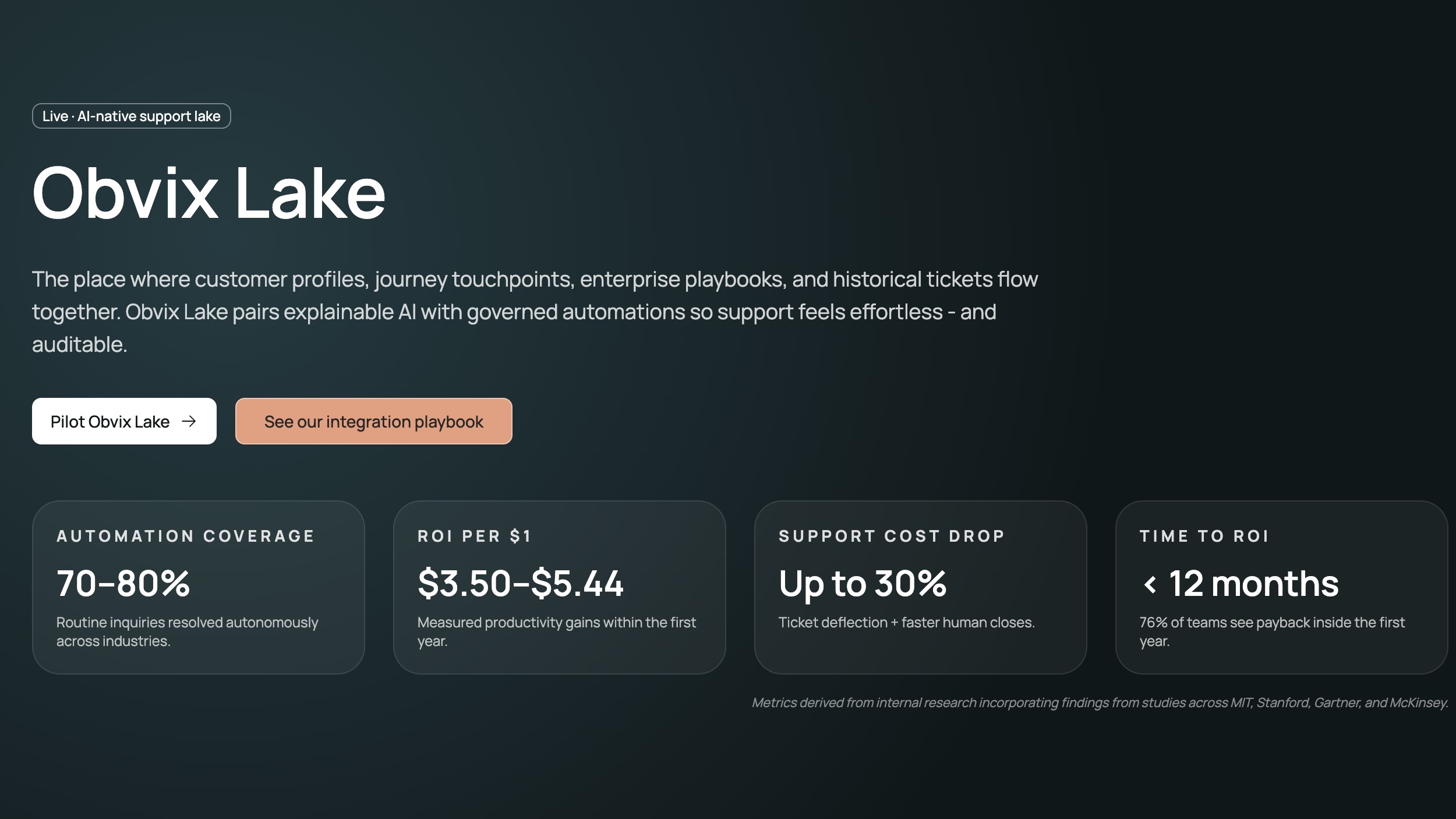
Obvix Lake
Built and integrated a production-ready AI support orchestration console, making complex backend workflows usable through a clean, operator-first frontend.
At Obvix Lake, I led frontend console development with React + TypeScript and tightly integrated it with Flask APIs to support real support-team workflows. I delivered responsive modules for dashboard metrics, chat operations, ticket orchestration, review queues, KB workflows, and trend analytics with clear hierarchy and fast operator navigation.
Project At A Glance
Timeline
Dec 2025
Industry
AI · Enterprise · SaaS
Contribution
UI/UX design, frontend console architecture, backend integration, analytics surfaces, and smooth support workflows
Collaboration
Project Visual
Obvix Lake
Summary
What this project demanded.
At Obvix Lake, I led frontend console development with React + TypeScript and tightly integrated it with Flask APIs to support real support-team workflows. I delivered responsive modules for dashboard metrics, chat operations, ticket orchestration, review queues, KB workflows, and trend analytics with clear hierarchy and fast operator navigation.
Role
Frontend Developer
Year
2025
Problem Space
The core challenge was exposing hybrid RAG orchestration logic in a way agents could trust instantly: confidence cues, citations, escalation outcomes, persona behavior, and ticket context all had to be visible without clutter or state confusion.
Operators needed to move across chat, ticket state, review queues, knowledge management, and metrics while understanding why the AI responded a certain way. The frontend had to surface confidence, citations, knowledge status, and escalation decisions with clarity instead of dashboard noise.
Capability 01
React
Capability 02
TypeScript
Capability 03
Flask
Capability 04
Hybrid RAG
Product Lens
Obvix Lake had to feel like an operating system for AI-assisted support.
The platform spans conversational AI, hybrid semantic + BM25 retrieval, self-RAG validation, GLPI escalation, document ingestion, and analytics. My job was to shape the frontend so operators could understand what the system knew, what it was uncertain about, and what action should happen next.
01
Operator expectations
- See AI answers, citations, and confidence signals without reading a wall of system detail
- Move fast between ticket routing, chat context, and knowledge review tasks
- Understand when the system should assist, validate, or escalate to a human agent
02
Backend realities
- Hybrid RAG combines embeddings and BM25 with multi-stage validation gates
- GLPI workflows require ticket sync, escalation context, and knowledge extraction from resolved tickets
- The console must support analytics, multi-persona support, KB queues, and chat within one coherent interface
Signal
60/40
Hybrid retrieval balance between semantic embeddings and BM25 lexical search
Signal
1 loop
Closed-loop learning from resolved GLPI tickets into the knowledge base
Signal
real-time
Analytics, issue clustering, and support console feedback surfaced in one product
Insight
In support products, trust comes from visibility. Operators need to see why the system responded, not just the response itself.
Core Interaction Shifts
The product decisions that changed how the experience felt.
Shift 01
Operator-Friendly Chat Experience
Mapped orchestration behavior into readable UI states including typing progress, citations/sources, confidence signals, and escalation outcomes.
Shift 02
End-to-End API Integration
Integrated frontend flows with backend endpoints for chat, personas, routing, review actions, analytics, feedback, and health checks with robust error handling.
Shift 03
Scalable State + Component Architecture
Implemented predictable multi-step state flows and reusable typed components so the console remains maintainable as personas, KB sources, and analytics views expand.
Influence & Validation
What changed because of the work.
The orchestration engine became a practical day-to-day product: fast, understandable, and reliable for real operators handling live support workflows.
Complex backend capabilities surfaced clearly without overwhelming the UI
Improved reliability through resilient loading/error handling and edge-case coverage
Reusable typed frontend foundations established for continued feature growth